
Legal reading of category-based Express Entry indicates authorized, paid RA/TA work and properly documented self‑employment during studies may fulfill the one‑year researcher-category experience requirement (separate from CRS/CEC rules). This could open a PR pathway for many Iranian PhD students, though applicants face higher evidentiary burdens and potential inconsistent adjudication.
Soheil Hosseini
March 17, 2026
Jurisdiction
Federal
Week
Week 12
Impact
Moderate
Programs Affected
Category-Based Express Entry Could Open Path to Permanent Residence for Iranian Researchers
Date: 2026-03-17
Summary: A legal reading of recent category-based Express Entry rules suggests that authorized, paid research and teaching work performed by Iranian students in Canada — including self-employment — may count toward eligibility for researcher-focused draws, potentially creating a meaningful pathway to permanent residence. Canada’s evolving category-based Express Entry system for the researchers and academics category could open a new route to permanent residence for many Iranian nationals. Iranian students occupy a significant share of Canada’s doctoral programs and often hold paid research assistant (RA) and teaching assistant (TA) roles, positioning them to meet category eligibility if their experience qualifies. At issue is whether paid research/teaching work performed during studies can satisfy the category requirement of at least one year of work experience in the past three years. While many assume student work in Canada never counts under Express Entry, the law distinguishes among different tests within the system. According to the Ministerial Instructions referenced in the update, to be a “member of the category,” candidates must have:
- at least one year of full-time (or equivalent part-time) experience in an eligible occupation within the last three years;
- performed the NOC lead statement and a substantial number of main duties, including all essential duties. Crucially, the Instructions explicitly exclude only unauthorized work in Canada from counting toward this category experience. There is no stated blanket exclusion for work performed while studying or for self-employment for the purpose of category membership. This distinction matters. The rule for category eligibility is legally separate from:
- claiming CRS points for Canadian work experience,
- meeting the Canadian Experience Class (CEC) criteria, and
- other program-specific qualifying experience rules. Put differently, what does not count for CRS points or CEC may still count for category membership, and the rules should not be conflated. A reasonable reading of the Instructions suggests that authorized, paid work performed during studies (for example, work permitted under R186(v)) and properly documented self-employment can be accepted for category eligibility. Officer guidance further underscores that “work” for this purpose means activities for which wages or commissions are paid, and while self-employment is not barred, it requires robust third-party evidence (e.g., incorporation records, proof of income, client documentation). Practical takeaway: For the researchers and academics category, authorized paid RA/TA roles and documented self-employed research work may count if the experience:
- was authorized (not unauthorized work in Canada),
- matches the relevant NOC lead statement and main/essential duties,
- totals at least one year within the last three years, and
- is supported by credible evidence. Implications for Iranian researchers: Given their strong presence in Canadian PhD programs and frequent engagement in paid RA/TA positions, Iranian candidates could find a clearer pathway to PR through category-based draws aimed at researchers and academics. Independent analysis (potential impacts):
- Positive:
- Broadens access for qualified Iranian doctoral candidates;
- Aligns selection with Canada’s research and innovation needs;
- Clarifies that authorized student work may support category eligibility.
- Risks/limitations:
- Inconsistent adjudication is possible if applicants or representatives conflate category eligibility with CRS/CEC rules;
- Higher evidentiary burden for self-employment could trip up applicants lacking third-party documentation;
- Policy or guidance updates could narrow interpretations;
- No guarantee of invitation: draw sizes, frequency, and category cut-offs still govern selection.
Programs affected: Express Entry (category-based selection); Canadian Experience Class (clarified as a distinct framework with different rules). Source: News Article; Ministerial Instructions and officer guidance as cited in the update.
Tags: Canada immigration, Express Entry, Category-based selection, Researchers, Academics, Iranian students, Permanent residence, RA/TA work, Self-employment, Authorized work, R186(v), NOC, CRS, CEC, Ministerial Instructions In sum, the current legal reading points to a pragmatic opening: for many Iranian researchers, authorized, paid academic work may be leveraged for category membership, potentially transforming study and research experience in Canada into a viable PR pathway through category-based Express Entry draws.
Categories
Share This Post
Stay Updated with Immigration News
Get the latest updates on Express Entry draws, OINP invitations, policy changes, and more delivered to your inbox.
We respect your privacy. Unsubscribe at any time.
Related Articles
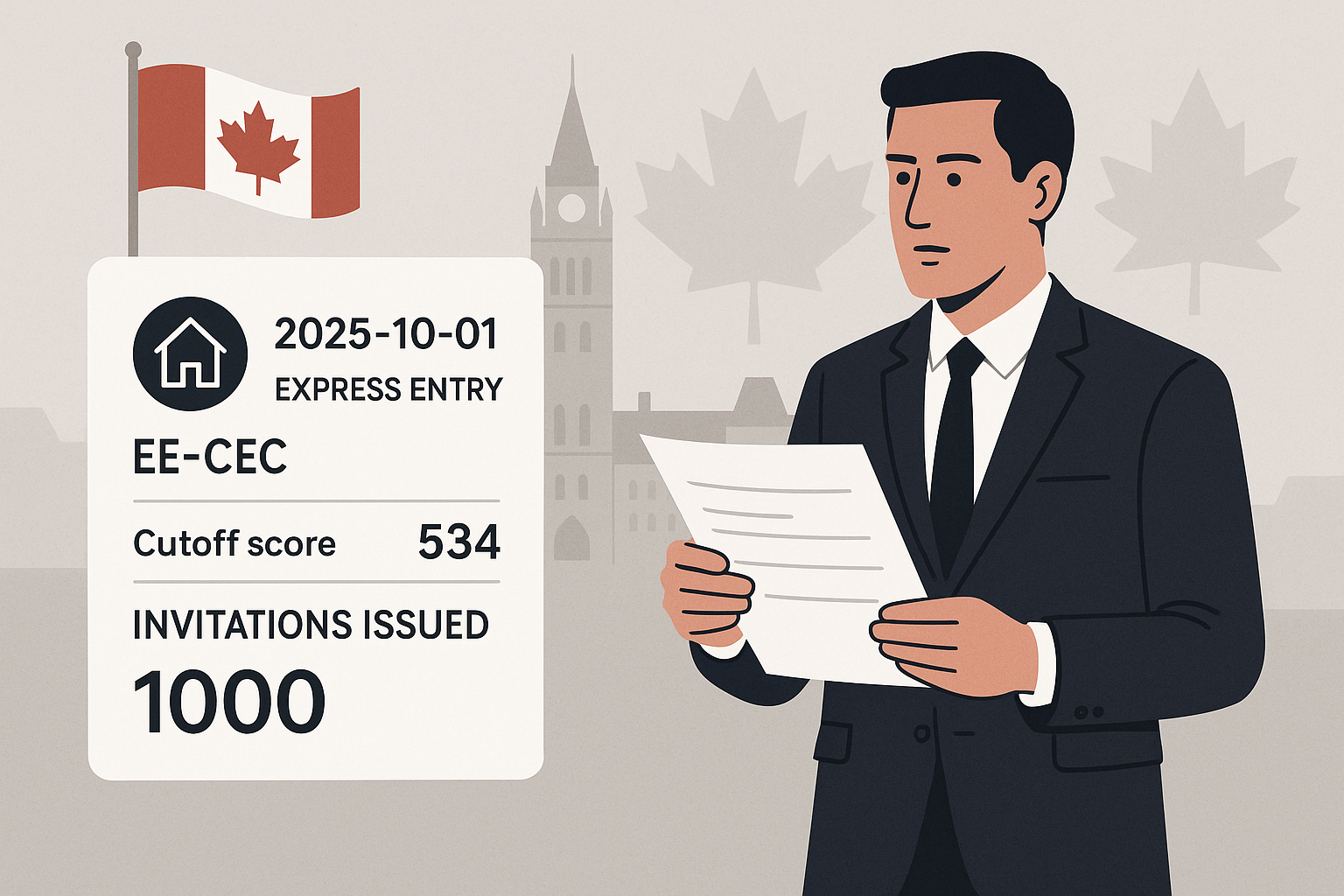
1,000 CEC Invitations
On 2025-10-01 Canada’s Express Entry CEC draw issued just 1,000 ITAs with a high CRS cutoff of 534, prompting criticism of federal priorities. Critics say the small, high‑cutoff CEC round—contrasted with larger francophone draws—undermines temporary‑to‑permanent transitions for in‑Canada workers.

EE-PNP Draw CRS 855
On 2025-09-29 ImmiWatch reported an Express Entry EE-PNP draw issuing 291 invitations with a CRS cutoff of 855, selecting provincially nominated candidates (General category, all regions). The high cutoff and limited invites prioritize PNP nominees and restrict movement for non-nominated Express Entry candidates.

EE-PNP Draw 746 CRS
Express Entry EE‑PNP issued 228 ITAs at a 746 CRS cutoff (update 2025‑09‑16), reflecting provincial nominations. A follow‑on draw is anticipated tomorrow but has not been officially confirmed.

OINP-FWS: 1,134 invites
Ontario’s OINP‑FWS issued 1,134 invitations province‑wide on 3 Sep 2025 under Other Priority Occupations with a PNP cutoff score of 42 (PNP update 4 Sep 2025). This large round may indirectly affect OINP‑JOIS pacing and nomination allocations.